

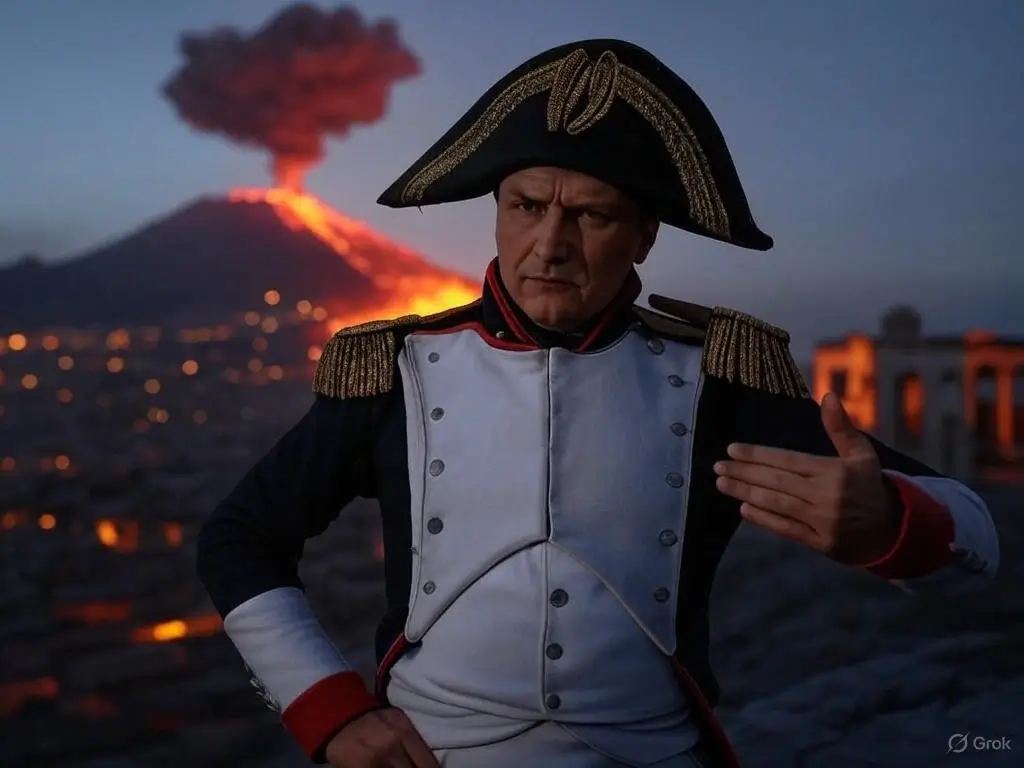
Napoleon Bonaparte: The Italian-Romanian Firebrand Who Conquered France (and Our Hearts)
In a shocking twist of historical fan fiction, new evidence (entirely fabricated for your amusement) reveals that Napoleon Bonaparte, the pint-sized powerhouse who once ruled half of Europe, wasn’t French at all! Forget the Corsican birthplace dusty textbooks have spoon-fed you—our reimagined Napoleon hails from the sun-soaked streets of Naples, Italy, with a dash of Romanian spice thrown in for good measure. Buckle up, history buffs, because this is the tale of Napoleon Buonarroti (yes, we’re giving him an Italian flair), the Neapolitan-Romanian whirlwind who bamboozled France into making him emperor.
A Childhood of Pizza and Passion
Born on August 15, 1769, in a bustling Naples alleyway, little Napoleone Buonarroti came into the world screaming—not in French, but in a melodious mix of Neapolitan dialect and his mother’s Romanian lullabies. His father, Giuseppe Buonarroti, was a fiery Neapolitan fisherman with a knack for storytelling and a mustache that could intimidate a shark. His mother, Dragomira Popescu, a Romanian beauty with a penchant for dramatic escapes, had fled the Carpathian Mountains after a scandal involving a runaway goat and a local nobleman. The two met during a chaotic Naples fish market brawl, fell in love over a shared plate of spaghetti, and soon welcomed their ambitious bundle of joy.
But paradise didn’t last. When Napoleone was just five, Dragomira tired of Giuseppe’s endless fish tales and filed for divorce—an act so scandalous in 1770s Naples that it made the local gossip sheets (literally sheets hung out to dry with rumors scribbled on them). With her son in tow, Dragomira packed up her Romanian recipes and headed north, eventually landing in France after a detour through a suspiciously goat-free Alpine village.
From Naples to Nice: The Making of a Legend
Young Napoleone arrived in France with a thick Neapolitan accent, a love for garlic-heavy cuisine, and a chip on his shoulder the size of Mount Vesuvius. The French kids mocked his penchant for gesticulating wildly and his habit of yelling “Mamma mia!” during schoolyard scuffles, but Napoleone didn’t care. His mother remarried a minor French bureaucrat, Pierre LeSnob, who reluctantly adopted the boy and enrolled him in a military academy—mainly to get him out of the house, where he kept setting fire to things “for dramatic effect.”
At the academy, Napoleone’s Italian flair and Romanian stubbornness made him a standout. He excelled at strategy, reportedly winning a chess match by throwing the board at his opponent and declaring, “Checkmate, you French fry!” His professors, baffled but impressed, fast-tracked him into the army, where he quickly rose through the ranks by sheer force of personality and a suspiciously well-timed volcano metaphor during every battle speech.
Emperor of Everything (Except Good Hair Days)
By 1799, Napoleone—now calling himself Napoleon Bonaparte to sound more French—had seized power in a coup so theatrical it included a live orchestra and a cameo by his mother waving a Romanian flag. His Neapolitan roots shone through in his love of grand gestures: he once ordered an entire fleet of ships to sail in a pizza-slice formation just because it “felt right.” His Romanian heritage, meanwhile, fueled his relentless ambition—rumor has it he kept a vial of Transylvanian soil in his pocket for luck, though some say it was just dirt from his last tantrum.
Napoleon’s conquests across Europe were less about French glory and more about proving that a kid from Naples could outsmart anyone. He famously declared, “I’m not short—I’m just concentrated power, like a good espresso!” His soldiers adored him, especially after he introduced them to Neapolitan pizza during the Russian campaign (spoiler: it didn’t help with the cold).
The Fall of the Garlic King
Alas, even a Neapolitan-Romanian dynamo couldn’t rule forever. After his disastrous 1812 invasion of Russia, where his troops ran out of oregano and morale, Napoleon’s empire crumbled. Exiled to Elba, he spent his days perfecting a pasta recipe and muttering about how France never appreciated his genius. His final comeback at Waterloo in 1815 ended in defeat, but not before he shouted, “I’ll be back—stronger, spicier, and with better cannons!” He wasn’t, though. He died in 1821 on Saint Helena, reportedly clutching a half-written letter to his mother asking for her secret goulash recipe.
Legacy: A Spicy Footnote in History
So, there you have it: Napoleon Bonaparte, the Neapolitan-Romanian rogue who tricked the world into thinking he was French. Was he a military genius or just a guy with too much garlic and grit? We’ll never know—mostly because this is all delightfully fake. But next time you bite into a pizza or hear a dramatic violin solo, spare a thought for Napoleone Buonarroti, the little emperor with a big appetite for chaos. Mamma mia, what a guy!
